Michel Lamoller | Touched Nature


About the exhibition
Michel Lamoller | Touched Nature
With the exhibition “Touched Nature,” the Samuelis Baumgarte Gallery presents a new phase of work by Michel Lamoller, in which nature no longer appears as a distant landscape, but as a contact zone—something that has been touched and, at the same time, touches us. The exhibition title describes more than an ecological state: it formulates an attitude of seeing.
Lamoller's works demonstrate that nature today is never untouched. It is marked, reshaped, altered. And it is precisely in this contact—in the intervention, in the trace, in the metamorphosis—that a fragile, peculiar beauty unfolds.
From photographic image to relief-like image body
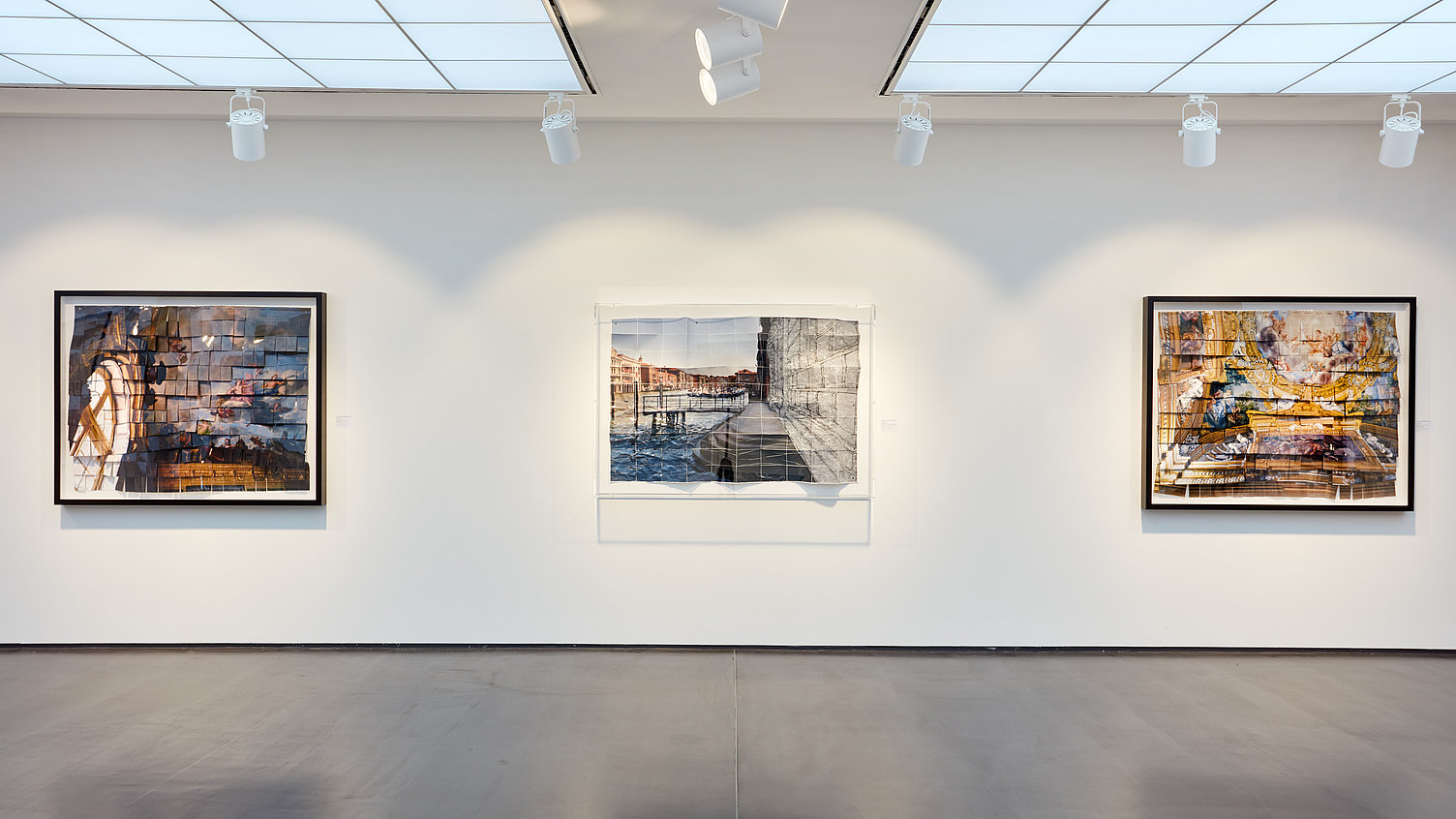
The starting point for his works is photography, or more precisely, a contemporary form of lens-based photography. Real, documentary surfaces of the world are first captured and fixed optically. But Lamoller does not stop at the image. He alienates, layers, and superimposes until relief-like image bodies emerge.
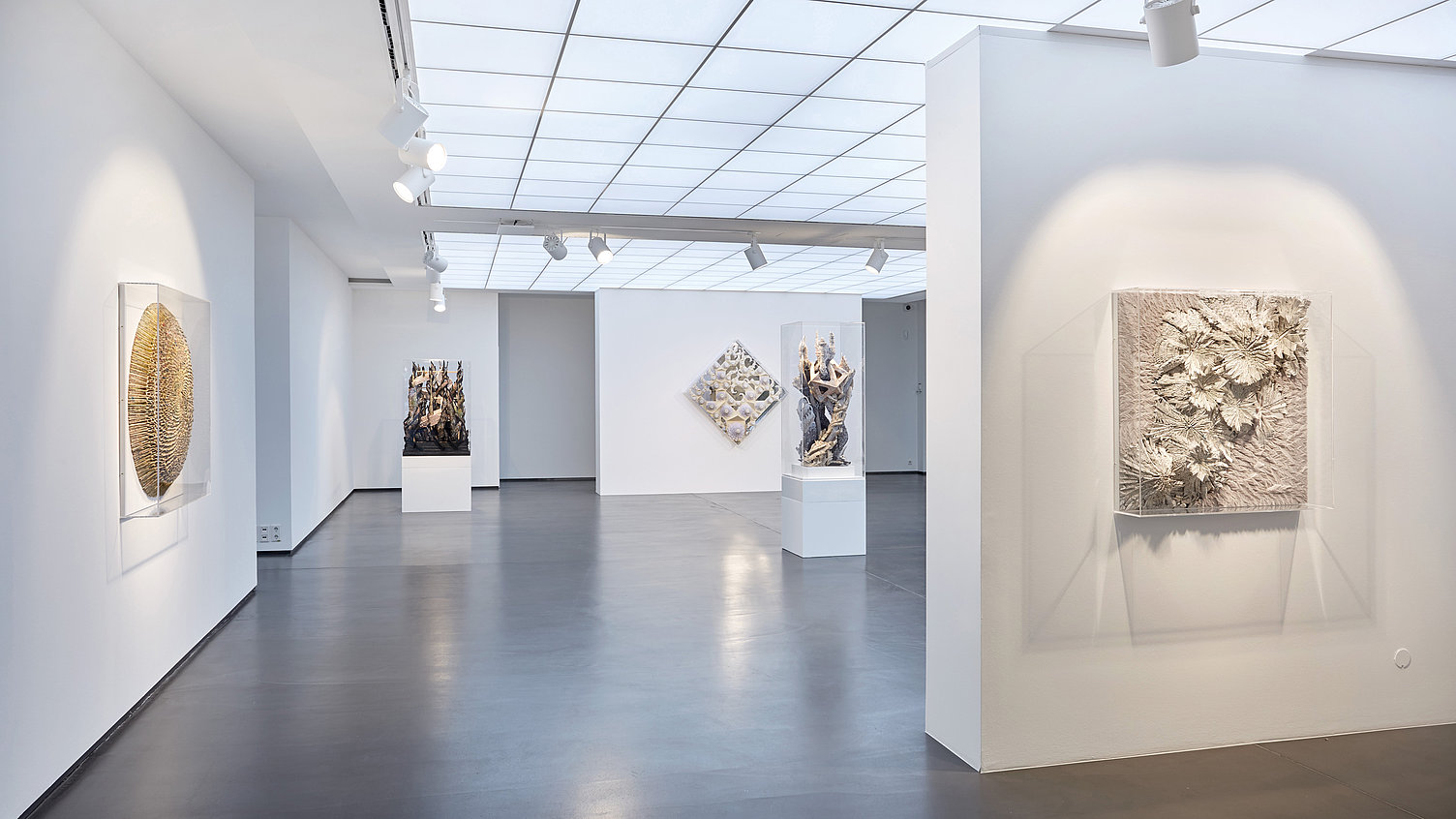
Photography becomes matter. Surface is transformed into layering, into condensation, into trace. The image becomes not a window, but a body. Nature appears not as a landscape given “in itself,” but as a surface that has passed through history—as sediment of the Anthropocene.
Works such as Anthropogenic Mass 2 (2021) and Anthropogenic Mass 4 (2022) already appear like tectonic plates of a touched world. Photographic fragments condense, tear open, and overlap. The surface of the image becomes a relief, as if the earth itself had inscribed itself.
Nature in the Anthropocene
In Anthropogenic Mass 6 (Japan) (2022), the Earth's surface appears mapped and at the same time distant. Traces of infrastructure, cultivation, and industry become visible—not spectacularly destructive, but profoundly transformative.
Later works such as Anthropogenic Mass 12 (2024) and Anthropogenic Mass 22 (2025) further develop this technique. Each layer preserves the memory of what came before, each overlay is an imprint of time. The photographic image becomes topography.
Lamoller thus shifts the tradition of photography into the realm of expanded and sculptural photography. The image is no longer merely a carrier of visibility, but a physical object—a stage on which surface, space, and memory can be experienced plastically.
Tradition and the present in dialogue
In this materiality, Lamoller touches on artistic shifts in modernity and the present—one thinks of Robert Rauschenberg's Combine Paintings or the relief-like surfaces of Antoni Tàpies. At the same time, his pictorial thinking reaches far back: even the landscapes of the 17th century, for example those by Jacob van Ruisdael, were emotional condensations of atmosphere and existence.
Lamoller continues this tradition—but under the conditions of a present in which the landscape has been irrevocably altered. His works are seismograms of a world in transition.
Figure, Studio, Resonance Chamber
In his portraits, Lamoller shows artists in their studio atmospheres—spaces of concentration, retreat, and aesthetic condensation. The figures do not appear isolated, but as a quiet presence within the scene – like contemporary resonance figures of a touched landscape.
This creates a poetic pictorial space in which work, architecture, figure, and nature intertwine. The landscape becomes not only a scene of traces, but a space of being-in-the-world.
Contemporary Nature – a touched paradise
The Contemporary Nature series opens up a second level. Here, too, photography remains the starting point, but nature appears dreamlike, exaggerated, fragile, and at the same time intensely present.
Contemporary Nature 10 (Eden I) (2025) is reminiscent of the motif of the Garden of Eden – an Arcadia with reservations, a touched Eden. In Contemporary Nature 11 (cherry blossom) (2025), the blossom becomes a sign of beauty that already contains transience in the moment of its radiance.
Nature and civilization no longer appear here as opposites, but as interlayered realities. Vegetation, architecture, and technological markers form a shared present—everything is touched.
A double meaning
“Touched Nature” summarizes a double experience: nature is touched—by humans, by time, by history. And it is touching—because Lamoller does not show it as a finished image, but as a fragile surface of change.
The complex poetry of his overlays creates a quiet urgency. Lamoller opens our eyes to a world that is constantly rewriting itself—not as a definitive landscape, but as an ongoing metamorphosis. Surface, space, nature, and time remain in flux.
And we ourselves are part of this touch.
Video
Information
Opening reception, February 28, 2026, 5 p.m.
With artist talk, the artist will be present