
Pablo Picasso
Biography
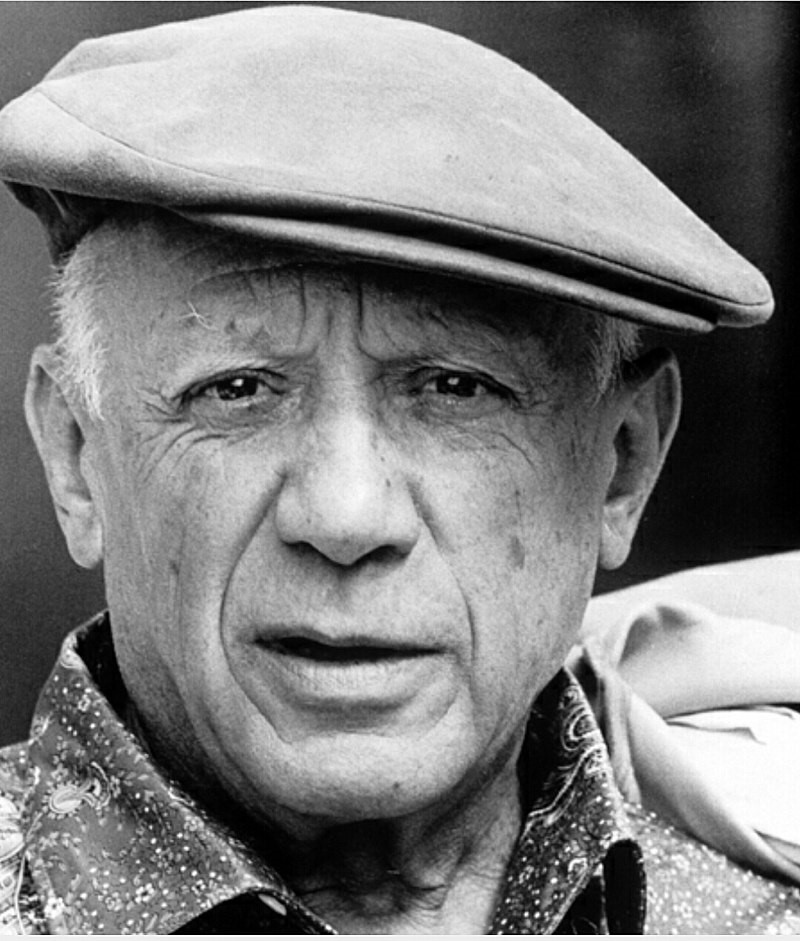
Pablo Ruiz Picasso was born on October 25, 1881 in Málaga, Spain. At the age of seven, Picasso received painting and drawing lessons from his father, he quickly revealed himself to be extremely talented, completed his first oil painting Picador at the age of nine, and was taught at the School of Fine Arts in Galicia at the age of ten. At the age of 14, he was admitted to the La Llotja Art Academy in Barcelona and skipped the first two classes. A year later he set up his first studio with his friend Manuel Pallarès. His early work is based on old master genre painting and depicts bullfighting scenes, pigeons and statues of Hercules. The first solo exhibition of his works took place in 1900 and Picasso traveled to Paris for the World Exhibition, where he was inspired by the impressionist works of Paul Cézanne and Edgar Degas. A year later he illustrated the issues of the art magazine Arte Joven. His work from this time is known as the Blue Period: a monochrome color scheme is at the forefront of the works, which takes up melancholy figure images and depicts marginal figures in society such as beggars, but also mothers and children. The Blue Period is characterized by a high degree of melancholy, triggered by the death of his friend Carlos Casagemas.
The monochrome use of the color blue is replaced by the pink period, which is dedicated to the world's motifs of actors and artists. The cubism art style, newly developed with Georges Braque, had a great influence on Robert Delaunay, Jean Metzinger and Fernand Léger. The famous painting “Les Demoiselles d’Avignon” from 1907, with its monumental dimensions, represents a turning point in painting and ushers in Cubism. It shows five women, some of whom are shown unclothed, against a bluish background. The slightly angular shapes reveal an abstract intention, as do the almost mask-like faces of the figures. The early phase of Cubism up to around 1912 is called Analytical Cubism, after which works were created that form an early form of collage and anticipate the art of quotation: It is called Synthetic Cubism. From around 1912, Picasso's works became increasingly important abroad. They can be seen in exhibitions at the Blauer Reiter, in London, and from 1911 also in New York in the Armory Show. Picasso's style changes again and combines elements from different styles. He began to develop his own formal language, experimented with sculptural works and inspired the surrealist movement around André Breton. In 1937, the monumental painting “Guernica” was exhibited at the World Exhibition in Paris. The well-known painting reflects the destruction of the city of Gernikas in World War II. The predominantly monochrome work combines geometric shapes, complex symbolism and figures in a sophisticated composition, some of which are reminiscent of people and others of animals. Two years later, the Museum of Modern Art in New York is showing a major retrospective of Picasso's work. His later years were inspired by Henri Matisse, whose style of painting influenced his work. He also deals with historical artists. In 1949, Picasso designed the poster with a dove for the Paris World Peace Congress, which became a worldwide symbol of peace. This was followed by two large murals and, in 1946, an exhibition of his paintings in the Louvre and the Pushkin Museum in Moscow. His style remains emphatically sketchy, works in a reduced manner, primarily with lines, and there is also a high degree of variation in themes. In 1962, Picasso was awarded the International Lenin Peace Prize, a year later the Museu Picasso opened in Barcelona and in 1970 there was another major retrospective of his work in the Louvre in Paris on the occasion of his 90th birthday. He is the first artist to receive this award during his lifetime. He died three years later on April 8, 1973 at his home in Mougins.
Pablo Picasso remains one of the most popular and influential artists of the 20th century. His extensive work includes paintings, lithographs, stage sets, curtains and costumes, as well as ceramics and was praised during his lifetime in exhibitions around the world and by fellow artists such as Salvador Dalí, André Breton and Max Ernst. His style paved the way for abstract art and influenced artists such as Robert Motherwell, Roy Lichtenstein, Joseph Beuys and Joan Miró.
The secret of art lies not in not looking, but in finding.
Museum and single exhibitions (selection)
2024
Die Sammlung – von Ernst Ludwig Kirchner bis Pablo Picasso, von Jackson Pollock bis Meret Oppenheim, Kunstmuseum Bern
Memoria Reciente, Centro Atlántico de Arte Moderno (CAAM), Las Palmas de Gran Canaria, Spain
2023
Reverses, Museo Nacional del Prado, Madrid, Spain
2022
Pablo Palazuelo, Galeria Cayón, Madrid, Spain
2021
Dialecto Ca, 2mCA2M - Centro de Arte Dos de Mayo, Madrid, Spain
2020
Picasso and Paper. Royal Academy of Arts. London, United Kingdom
2019
Picasso Printmaking as Experiment. Städel Museum. Frankfurt/Main, Germany
2018
The Ey Exhibition: Picasso 1932 – Love, Fame, Tragedy. Tate Modern. London, United Kingdom
2017
Picasso: On The Beach. Peggy Guggenheim Collection. Venice, Italy
2016
Picasso. Sculptures. Palais des Beaux-Arts (BOZAR) Brussels, Belgium
Picasso and his Printers. Los Angeles County Museum of Art (LACMA) Los Angeles, CA, United States
2015
Picasso Sculpture. Museum of Modern Art (MoMA) New York City, NY, United States
2014
Pablo Picasso - From Arcadian Bliss to Painted Exorcism. Moderna Museet Malmö, Sweden
2012
Picasso Black and White. Solomon R. Guggenheim Museum, New York City, NY, United States
2010
Picasso in The Metropolitan Museum of Art. The Metropolitan Museum of Art. New York City, NY, United States
2008
Focus: Picasso Sculpture. Museum of Modern Art (MoMA) New York City, NY, United States
2005
Picasso – Badende. Staatsgalerie Stuttgart, Germany
1997
Pablo Picasso. Städel Museum, Frankfurt/Main, Germany
1993
Picasso in Budapest. Hungarian National Gallery. Budapest. Hungary
1988
Le dernier de Picasso 1953 – 1973. Centre Pompidou. Paris. France